Case Study
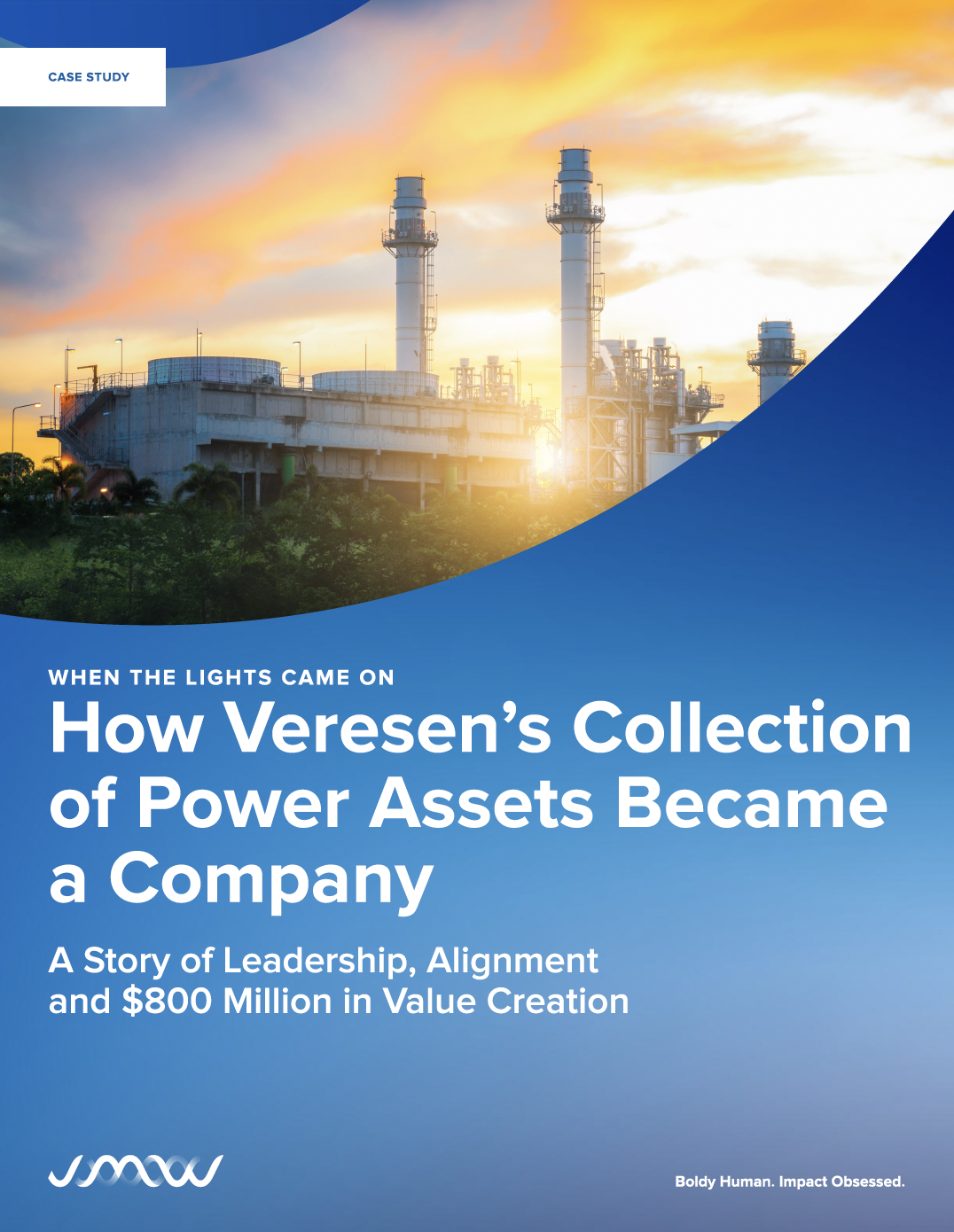
When the Lights Came On: How Veresen’s Collection of Power Assets Became a Company
The hidden opportunity no one could see yet
Veresen's power business wasn't built as a single enterprise.
Over time, Veresen assembled a diverse portfolio of power generation, district energy and renewable energy assets across North America. Individually, many performed well. Collectively, however, they had never fully become something greater than the sum of their parts.
By the mid-2010s, Veresen was directing significant capital toward natural gas infrastructure projects, reflecting the growing strategic importance of its midstream, pipeline and LNG businesses. As leadership considered the future of the power portfolio, a critical question emerged: What was this business capable of becoming? The challenge was not simply one of strategy. It was one of possibility.
Could a geographically dispersed portfolio begin operating as a single enterprise? Could leaders who had historically focused on individual operations create a shared future, a shared purpose and a shared standard of performance?
The answer to those questions would ultimately reshape the business, create hundreds of millions of dollars in additional value, and change what the leadership team believed was possible.

What was this business capable of becoming? The challenge was not simply one of strategy. It was one of possibility.
A collection of assets. Not yet a company.
When Paul Eastman stepped into a senior leadership role at what would become Veresen Power, he inherited something most investors would have considered a liability disguised as an asset. Scattered across North America — California, British Columbia, Alberta, Prince Edward Island, Ontario — were more than eleven power generation operations. Each plant ran its own playbook. Each management team spoke its own language. None of them had a particular reason to talk to the others.
The portfolio's strategic problem was fundamental: a collection of unrelated boxes on a map is not a business.
The challenge was to transform a collection of successful assets into a company — one capable of creating more value together than any of its operations could create alone. As the company considered its long-term strategic options, including the possibility of an eventual sale, it became clear that disconnected assets would not command a premium.
In a competitive M&A market, a fragmented portfolio gets broken up for parts or sold at a discount to whoever will take the complexity off your hands.
Buyers would pay for something different: a business that could demonstrate enterprise capability, strategic coherence, and sustainable performance.
The capital project dimension made things harder still. Among the portfolio's most consequential bets was a peaker plant contract in the York region near Toronto — a high-stakes, high-visibility build that required the full institutional weight of the organization to execute well. That weight didn't yet exist.
"On day one, you have eleven operations sitting around that don't have a synergistic sort of value to them. They're just boxes scattered around North America. Why would I buy that?" — Paul Eastman, Former Vice President, Operations, Veresen
What JMW brought into the room — and what the room did with it.
JMW's engagement with the Veresen Power leadership team was not a restructuring exercise, a strategy refresh, or a process overhaul. It was something more foundational: a shift in how the people running this organization understood their collective purpose — and their collective power.
The work was deliberately designed to operate at multiple levels of the organization. Leadership teams aligned around a common strategic direction. Individual facilities engaged their teams in that future and the performance required to deliver it. Plant managers received ongoing coaching.
Project teams responsible for critical growth initiatives were brought together around shared commitments and accountability. Rather than treating each challenge in isolation, the effort focused on creating organizational coherence across the entire portfolio.
The work brought dispersed management teams together — not just geographically, but philosophically. This effort was about changing leadership mindsets and becoming one team working together.
For the first time, a plant manager in California and his counterpart burning biomass in Charlottetown, PEI, found themselves in the same room, working on the same problem. What emerged was not manufactured alignment. It was the discovery that alignment had been possible all along — that these people had ideas for each other, resources to offer each other, and a shared stake in something larger than their individual operations.
"The magic is: I work over there, and I have an idea for you — and you're willing to listen to that, and we could work on that. That was it. That was the moment." — Paul Eastman, Former Vice President, Operations, Veresen
JMW introduced a triage-based approach to resource allocation: when you wake up every day, at the leadership level, where is the highest-priority need in the portfolio today? That clarity, deceptively simple, changed how the organization moved. It concentrated human energy. It created accountability. It made the York peaker plant not just the problem of the project team, but the shared priority of the enterprise.
And something else happened that no process document could have predicted. People who had previously operated in isolation — comfortable, perhaps, in their silos — began proposing things they never would have raised before. New government relationships materialized.
Contract structures once considered fixed were renegotiated in ways the utility hadn't imagined when it originally awarded the deal. The organization became, in Eastman's words, creative — an adjective rarely associated with the utility sector.
"We were in a utility setting, in a place that was very stuffy and old and traditional in Ontario — and we became very creative. We did things with that peaker contract that they never imagined were possible." — Paul Eastman, Former Vice President, Operations, Veresen
"The magic is: I work over there, and I have an idea for you — and you're willing to listen to that, and we could work on that. That was it. That was the moment." — Paul Eastman, Former Vice President, Operations, Veresen
When The Lights Came On
The York peaker plant was optimized in ways that unlocked its full capacity payment structure — a highly lucrative arrangement where the real value lies in being available, not running.
That relationship with the Ontario utility opened a second 20-year contract for a district energy provider in another large municipality. Long-duration, high-value government capacity contracts are not won by fragmented organizations. They are won by organizations that have demonstrated they can function as one.
When the portfolio was ultimately brought to market, the transformation was visible to buyers in a way that pure financial engineering rarely achieves. The exit multiple — estimated to have moved from approximately 4× to over 13× — reflected not just the contracts on paper, but the organizational coherence behind them.
Buyers were acquiring a business, not a collection of liabilities. The estimated incremental value created through the period of JMW engagement is approximately $800 million.

"JMW put us through a process that fundamentally transformed our top line and bottom line. They got a disparate business to change its mindset about the value it was losing by working without a common purpose. And when the lights went on — people proposed things they never would have.
We had new opportunities with government providers. The multiple went from what might have been a four to over thirteen. At the point we sold, this process was accretive of $800 million."
Key Takeaways
Download the Case Study
When the Lights Come On: How Veresen’s Collection of Power Assets Became a Company

Get in touch with a member of our team
Inquire now